Feature Writing
Using Dirt to Change the World
Pashon Murray is using dirt to change the world.
Pashon created and operates Detroit Dirt, a composting organics diversion collection company, resource recovery advocacy and non-profit foundation in the city.
She founded it in 2010, as a pilot project to show that composting could be successfully used in an urban setting and designed it as a replicable model. Early contributors included the Detroit Zoological Society, which provided herbivore manure, General Motors, through a partnership with John Bradburn, which provided food waste from its Detroit-Hamtramck assembly plant, the Andiamo Detroit Riverfront restaurant at the GM Renaissance Center and Blue Cross Blue Shield.
Today, the 2 ½ acre site is busily turning waste from a number of businesses into compost and other resources. The resulting compost is sold to urban gardeners, local businesses, individuals, and really, anyone who wants it. You can even buy compost online from the Detroit Dirt website.
But, Pashon’s mission has always been bigger than just one composting business. The ultimate goal was creating a model that could be scalable while mitigating greenhouse gases.
“When we eliminate trips to the landfill with decentralizing compost sites, we reduce our carbon footprint. Why? The less we haul to landfills and the more we utilize fuel-efficient vehicles with composting technologies the better off the ecosystem is and humanity, “explains Pashon.
Today, she’s using the lessons healthy soil can teach to influence people and change behaviors in Detroit and around the world.
Pashon says her interest in the environment comes from experiences she had with her dad and grandfather. As a girl, she often went with her dad, an entrepreneur and contractor, to the local landfill. There, she began to understand the impact of waste on the environment. She also spent time with her grandfather on his farm and learned about the role of soil in farming.
The pivotal point in Pashon’s life was the discovery of green building practices that acknowledged waste as a resource. Growing up in Grand Rapids she discovered the waste industry and its antiquated practices, but decided to switch to a sustainable mindset that creates an economical perspective by designating a dollar value for the waste stream.
“I always knew it was destined for me. Not a lot of people find their purpose at a young age, but I was spiritually assigned to this purpose,” she says.
The idea for Detroit Dirt came when Pashon was working as an environmental justice consultant and lobbyist. For a project, she interviewed, and then got to know a Detroit urban farmer. He was composting on his farm. Pashon asked him if he wanted to work together to scale up and operate a larger model composting operation.
Contacts made at a local dinner for leaders in the community led to John Bradburn at GM. The urban farmer and cofounder identified the Detroit Zoo as a key supplier. These were her “seed” companies that allowed her to start the business and, basically, model the future business concept.
“Collaboration was key,” for the startup, says Pashon. “I knew if we had a global corporation and impactful organizations who were anchored in the community, they could validate the model we were building.”
This is an important learning Pashon shares with others who are working to implement environmental projects.
“Find companies that are aligned with your mission,” she says. “Find the individuals or ‘gems’ within these organizations. That might be someone working in an environmental capacity or maybe is just someone who shares your vision.”
She says she often sees people who keep knocking on the doors of companies they want to work with, but are not successful because the companies don’t share the same environmental mindset or awareness.
When she met John, she knew she had met a like-minded soul.
“The blessing was that John was a farmer,” says Pashon with a laugh. “His work within GM to eliminate waste was phenomenal, but it was key that he really understood the value of composting.”
Pashon encourages the young people she speaks to build relationships.
“The relationship with General Motors and the Detroit Zoological Society zoo was not the only factor,” in Detroit Dirt’s success, but it was important, according to Pashon.
“When you can mention people as advisors or mentors, or a company you are working with, that encourages others to support you as well,” says Pashon.
The key to success, according to Pashon, is education and awareness, and the creation of campaigns and curriculums.
The personal support provided by like-minded people can also be very important.
“John and others were a huge encouragement,” during the early stages of the business, says Pashon, introducing her to others in the community who could provide support. “John would often remind me that ‘hey, you’re pioneering’ and those conversations were very encouraging to me.”
In addition to establishing what she calls “great relationships,” there were a few other motivations going through her mind as she built Detroit Dirt.
“Being a woman and being a woman of color -- that encouraged me as well,” says Pashon “Earlier in my career when I was lobbying with a couple of other women in the environmental justice space, we noticed that a lot of times there were not any people of color in the meetings we were going to.”
Pashon was encouraged by those experiences to be a role model and to lead by example.
“I wanted to live in a city like Detroit so I could get younger black children to see themselves in the science space,” she says.
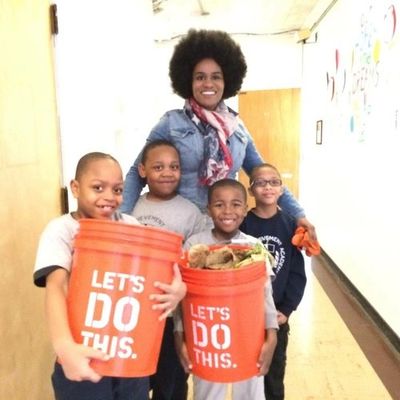
Today, Pashon is a much-in-demand speaker for school groups and other audiences.
“The soil is what I always bring it back to,” she says. “When they make the connection to the soil there is an awakening. It’s the same if it is a group of kids who are heading to ivy league colleges or are from inner city schools in impoverished communities, it doesn’t matter what their background is. Providing a pathway for careers that impact climate mitigation and the environment is why this work is of great value. The youth and young adults are the true essence of this work, it’s about generations to come.”
She ties healthy soil to the climate crisis, explaining how landfilling waste is an antiquated way to dispose of food waste that produces greenhouse gases. She tells stories of communities that were not able to grow their own food, but were able to use compost to build their land up to levels able to grow food again. She brings buckets of compost and manure and worms to the classroom.
“When we talk about climate change I tell them ‘if you want the same life that I have had, or your parents, or your grandparents, you need to do things differently, because the resources we have will not sustain unless you do something differently,’” Pashon says. "We have to keep the climate crisis as a priority and plan accordingly so we can sustain the ecosystem."
Pashon is planning to take those lessons to a wider audience. She has received a planning grant and is leading a team of educators to develop a curriculum to teach the lessons of healthy soil to K-12 students.
Younger students will learn about food waste and composting. Older students will compost and learn lessons tied to biology, chemistry and math. There will be expeditions to farms and sites where composting is taking place, aligning with STEM education is the answer.
“I want them to learn about composting, but I also want them to make the connection to their own career paths,” says Pashon. “They may not run a composting company, but I want them to say, hey, I could study environmental law and write policies, or teach, and design technologies or maybe be encouraged to be an entrepreneur.”
Pashon says; “The climate crisis impacts everyone, but it’s imperative that we all take a unified stance for best results. It’s time to invest in the soil. Our health and the health of the planet is top priority.”
Photo: Detroit Dirt